
The Douglastown Labyrinth
The act of creating, as much as its result—the appearance in our world of something that did not previously exist—has always filled me with wonder, whether the novelty in question is material or spiritual, individual or collective, completed or still in process.
In this regard, in the spring of 2001, the creation of a labyrinth on the grounds of the Douglastown Community Centre was a particularly powerful experience for me. In a very short period of time, I was able to witness the emergence of an innovative idea and the energy it generated in order to bring it to fruition.
It was Lorraine, my wife, who first suggested the labyrinth project—she who has always seemed like a bottomless well of new ideas. She spoke about what she envisioned to Isabelle Vilchenon, who was then the Centre’s assistant director. Isabelle, in turn, asked one of her friends, Geneviève Durocher, to volunteer her spare time to draw something that could serve as a plan for a later realization, without giving her any specifications whatsoever in terms of dimensions, level of difficulty, or type of materials to use. It was with this drawing, while she was looking for someone to finalize the project, that Lorraine asked me whether, in my opinion, the labyrinth imagined by Geneviève was feasible.
At first glance, I liked the drawing very much. It looked like a large bean, stretched from northeast to southwest, with beautiful curved shapes. Moving from the outer edge toward the centre, there appeared a succession of three long parallel paths, separated by hedges but interconnected by a clever network of passageways and dead ends. The very heart of the work was divided into three parts: two small inner chambers at the eastern and western ends—which at first made me think of heaven and hell—then, between these two open areas, a strange arrangement of short corridors perpendicular to the main long paths, leading nowhere except to a tiny central alcove, which in turn made me think of the limbo of Christians. As for the main entrance and exit, one was located to the north, the other to the south. Faced with such an interesting plan, I did not take long to answer Lorraine that yes, I believed the labyrinth was feasible, adding that I would be interested in taking charge of its construction, even though I already felt quite absorbed by my many responsibilities as a father, teacher, and gardener.
First of all, I went to assess on site where the best location for such a project might be on the grounds of the Community Centre. Then, based on the space available, I was able to establish a conversion scale for the general outline of the bean shape. However, before proceeding with transferring the drawing onto the ground, I had to make sure that the interior area planned for the project would be sufficient to allow for the planting of the hedges and the creation of all the intended paths. Obviously, to make such a verification, I first had to decide what the hedges would be made of and determine both their width and that of the paths.
I had no experience in planting hedges. I consulted the few gardening and horticulture books we had at home and, fortunately, I fairly quickly came to the conclusion that, in our case, the ideal choice would be to use cedars, since thousands of these trees grew in the surrounding area. Then, to make sure the hedges would be as dense as possible, I planned for them to be double hedges, consisting of two rows spaced 1½ feet (45 cm) apart, with the trees in each row planted 2 feet (60 cm) from one another and staggered with those in the opposite row. Thus, by adding the foot and a half of space between the two rows to the foot and a half of branch spread on either side, I needed 4½ feet (135 cm) of width for each hedge. As for the paths themselves, I did not want to allow for more than 3 feet (90 cm) in width, in order to foster a feeling of enclosure throughout the labyrinth.
With these measurements in hand, I quickly realized that Geneviève’s drawing included too many paths. It would be impossible to fit them all into the available space. The imagined maze therefore had to be simplified while preserving as much as possible the original concept and its main components. This was not difficult. The only change I had to make was to eliminate one of the three long paths that gave the bean its shape. In that way, everything was preserved, including the central chambers.
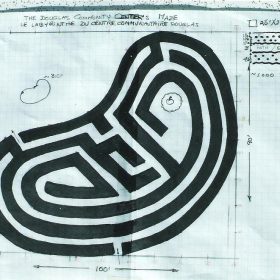
At that time, Henri-Paul Molaison, a friend of mine, was director of the Centre. Together, we worked on reproducing the final plan on the ground using the chosen scale of transfer. To begin with, using ropes, we laid out a rectangle measuring 90 feet (27.4 m) by 100 feet (30.4 m). Then, again using ropes, every ten feet (3 m), from east to west and from north to south, we marked out a grid identical to the one drawn on the plan. In this way, it was possible for us, and relatively easy, to indicate precisely on the ground, with small stakes, the various planting points (about 1,000) which would ultimately make it possible to create both the hedges and the paths at the same time.
It was not possible to complete this stage of the work in a single day. Lorraine came the next day to lend me a hand. Together, we managed to complete the central part of the maze, the most difficult because of its three interior chambers and its many short paths. What joy we felt, however, as we moved closer and closer to the centre and realized that, in the end, we would not run out of space to complete everything that had been planned! What joy as well to see, all around us, those hundreds of upright little wooden stakes, which, despite their apparent lack of organization, might one day be transformed into a magnificent labyrinth!
The task of finding and transporting the cedars we needed for the project caused no problem. I quickly found, in fact, a section of the ditches along Route 132 where thousands of these small trees were growing, barely two or three years old, and easy to uproot without even digging holes. With Henri-Paul’s help, in just a few hours of work, I had enough seedlings for our needs. The planting bee could begin.
Finally, on May 12 of that year, 2001, 18 volunteers answered the call issued by the Community Centre: a wonderful day of collective work in a pleasant atmosphere full of good cheer. Small groups naturally formed, often made up of a few planters and one person watering, and on their own initiative they set about completing one section or another of the layout. At each stake, one cedar; and since the seedlings were no more than 30 cm high, a single shovel thrust was enough to make a slit in the ground and insert the short roots. Thus, in less than four hours, everything was finished. The labyrinth had come into the world, still tiny, but complete and with all its components.
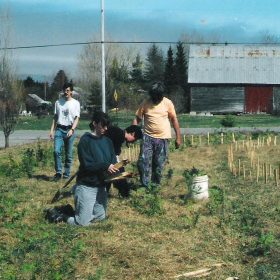
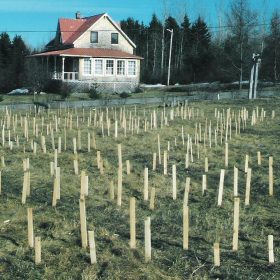
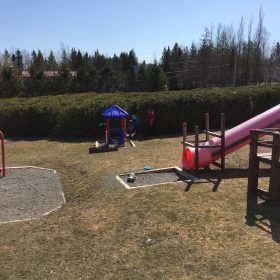
The transplanting was a success. Very few seedlings failed to survive. The following year, in May, Henri-Paul and I replaced about 75 of them. Two years later, in 2004, two of our sons, Gabriel and Jérôme, together with some of their friends, helped me make further corrections, this time by planting about forty new seedlings. In 2009, Lorraine came in turn to help me replace about one hundred seedlings that had not withstood the previous winters. Later, in 2015, two of our grandchildren, Félix and Laora, took part in modifying the original layout by moving the main entrance from the north to the west so that it would connect directly to the new playground the municipality had just installed next door. Finally, in September 2016, I resolved to fill in nine gaps that children had made in the hedges over the years. This repair was more complicated that time. First, because the cedars had already grown quite tall, I had to find new ones nearly two metres high and manage to make room for their large roots among all the others already there. Then, I had to conceal the new paths that had been created through these openings and make people forget them by laying sections of lawn there. It was worth the effort. In this way, the maze of paths regained the essence of its original route.
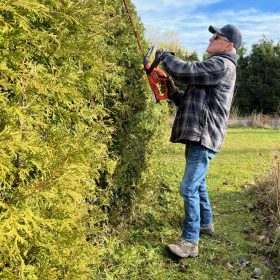
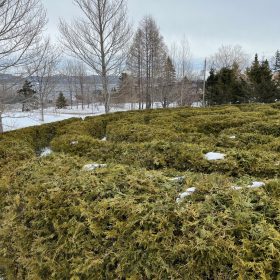
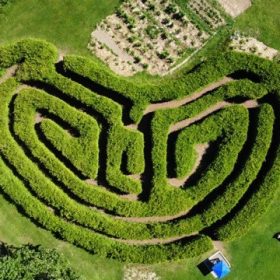

Over the past few years, the custodian of the Community Centre, Mr. Gérald Kennedy, has admirably ensured the labyrinth’s upkeep. He has regularly made sure that the paths retained their full width by trimming the lateral branches and, on a few occasions in the spring, when the snow turns into a crust capable of bearing weight, he has gone around all the trees to trim their tops. The whole is now mature and in excellent health, very popular with both children and their parents, who find in it an entertaining place, unique of its kind in the surrounding area. What was at first only an idea, born from Lorraine’s remarkably creative imagination, has now truly been in place for 20 years this year. Many people contributed to its realization. The whole community takes pride in it.
Louis Morin
Douglastown
January 25, 2021